


Research
Monitoring the ecological drivers of zoonotic infectious diseases requires high-resolution data on wildlife presence, movement, and interaction patterns. Biodiversity and species co-occurrence underpin the dynamics of pathogen spillover, yet generating continuous spatio-temporal datasets remains difficult in field conditions. To address this gap, researchers at Heidelberg have developed and tested a low-cost, Internet-of-Things (IoT) bioacoustics monitoring system designed to passively track vocalizing animal species and support research on infectious disease ecology. This research paper, “Prototyping an Internet-of-Things-based bioacoustics system to support research and surveillance of avian-associated infectious diseases,” is a report on the adaptation and testing of a bioacoustics Internet-of-Things system for passive spatio-temporal monitoring of avian species, situating its application within the context of zoonoses.
Prototype
The prototype system integrates a Raspberry Pi Zero 2W microcomputer, housed in a waterproof casing and powered by a lead-acid battery, for autonomous operation. Each unit is equipped with an omnidirectional microphone for privacy-preserving audio acquisition and GSM-based data transmission. The total cost per device is approximately €180, enabling scalable and distributed field deployment.
Central to the platform is Faunanet, an open and modular software environment supporting TensorFlow-based classification algorithms. Faunanet builds upon the BirdNET-Pi. The system facilitates an extension of future data collection beyond avian vocalizations and creates an open experimentation environment for developing new bioacoustics systems.
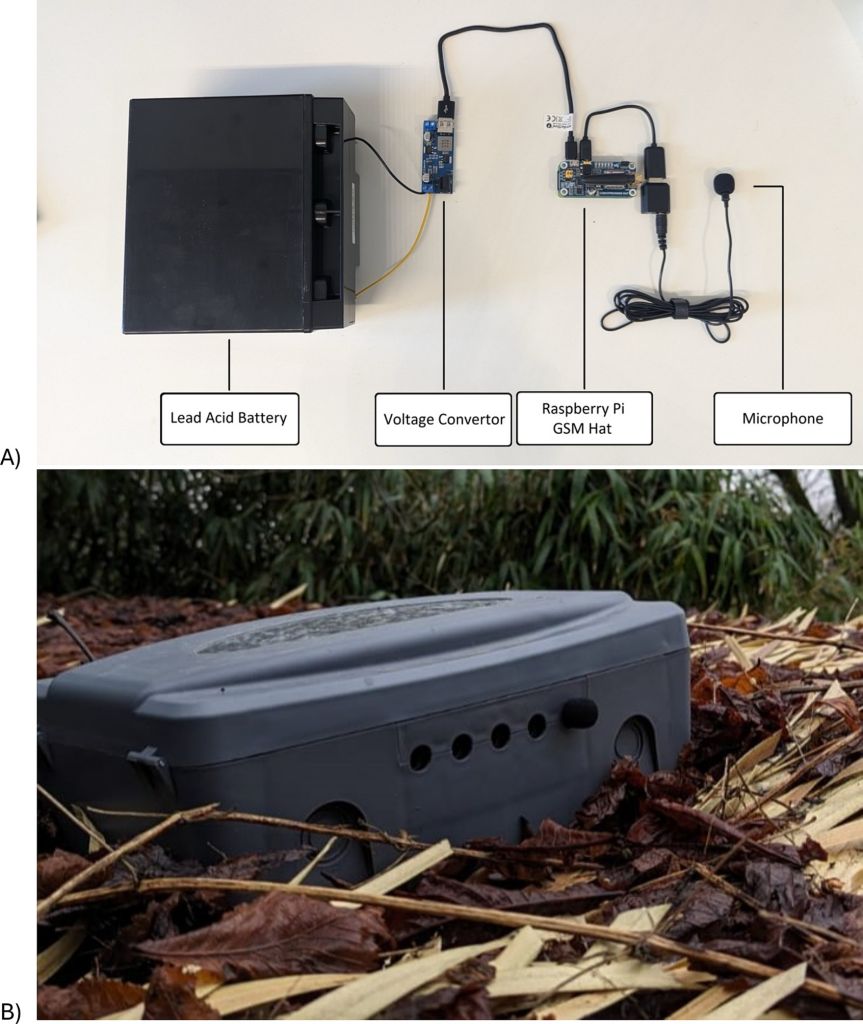
Fig. 1. Bioaco-record set up. Panel A) depicts the components of the assembled IoT device, and panel B) shows the protective casing for deployment in the zoo.
Method and Key Findings
Field work was conducted at Heidelberg Zoo across four test periods between November 2023 and March 2024. Devices were strategically positioned in mixed-species aviaries and open areas frequented by wild birds to capture a representative acoustic dataset. Over 700 hours of audio data were collected, from which the ML classification pipeline identified 57 distinct avian species. Classification accuracy was assessed against expert visual and auditory observations as well as historical eBird records, demonstrating robust concordance.
The prototype exhibited reliable performance under variable environmental and acoustic conditions. The system’s design ensures that human speech is not recorded, stored, or processed, satisfying privacy requirements for passive acoustic monitoring. The system is capable of adaptation to other taxa, supporting integration with broader ecological monitoring and zoonotic disease surveillance frameworks.
This study demonstrates the feasibility of combining bioacoustics and IoT infrastructure to produce cost-effective, high-resolution ecological datasets relevant to zoonotic disease research. The prototype supports autonomous, remote operation and scalable networked deployments.
Through an innovative Internet-of-Things (IoT) based bioacoustics monitoring system, the device provides an effective way to obtain datasets that support infectious disease research.
Read full publication here: https://www.sciencedirect.com/science/article/pii/S2214180425000832#s0060